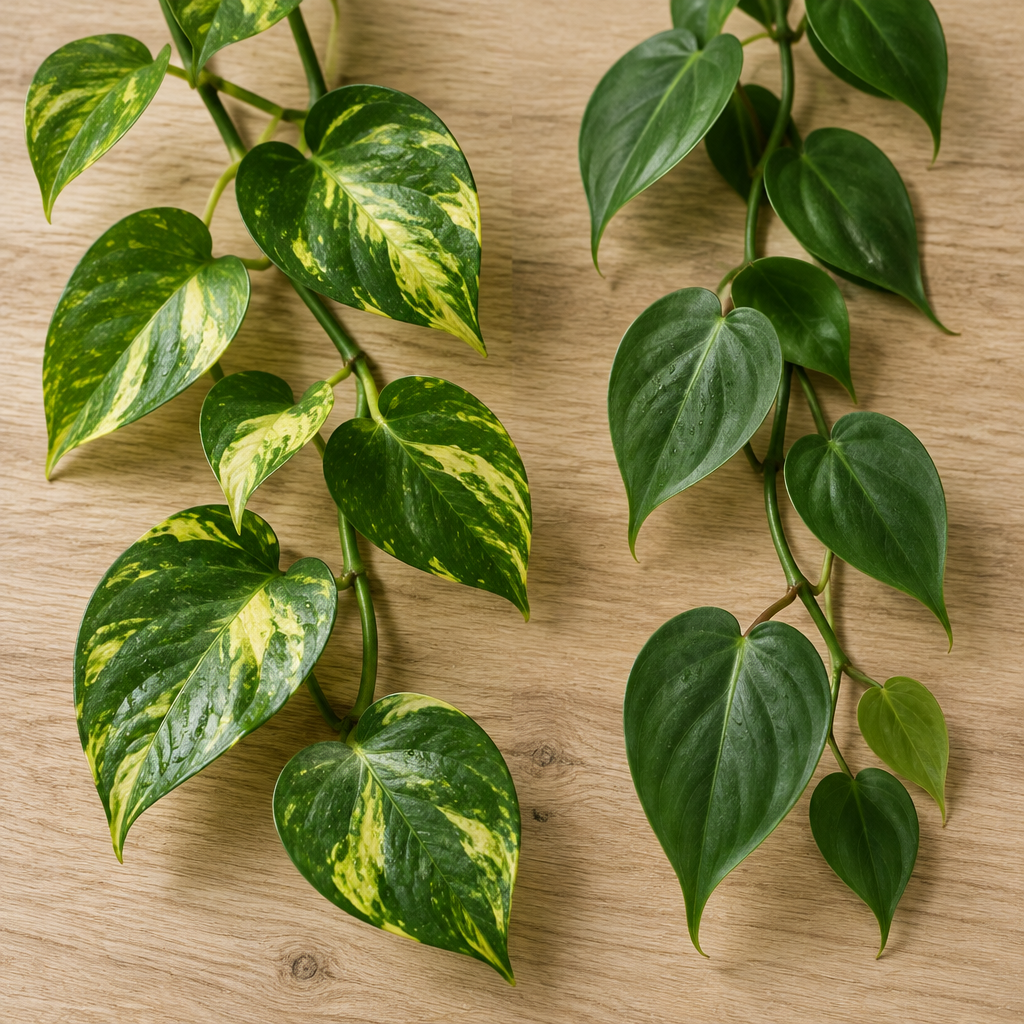
Pothos vs Philodendron: How to Tell These Two Look-Alikes Apart
Pothos vs Philodendron: How to Tell These Two Look-Alikes Apart
Walk through any plant section and you will see them stacked shoulder to shoulder: two glossy, heart-leaved trailing vines that look near identical on a shelf. One is a golden pothos, the other a heartleaf philodendron. Both are tough, both trail beautifully, and both have been quietly swapped in plant swaps and rescue pots for decades.
The confusion is forgivable. They are close relatives in the same family, Araceae, they grow the same way, and they are sold in the same sizes. But they are different plants with slightly different needs, and knowing which one you actually own changes how you water it, how fast it grows, and how you propagate it.
Here is how to tell them apart in about ten seconds, without needing a label.
Why they look so alike
Both are vining aroids from tropical forests, adapted to climb tree trunks in dappled light. Both produce aerial roots along the stem, both have leaves the general shape of a heart, and both are among the most forgiving houseplants sold. Under those similarities, though, sit four reliable differences: leaf shape, leaf texture, leaf emergence, and how the vine grows.
Test one: look closely at the leaf shape
This is the fastest check. Pick up a leaf and look at it head on.
Golden pothos (Epipremnum aureum) has slightly asymmetric leaves. The two sides of the heart are not quite mirror images, and the leaf sits a little crooked on the stem. The widest point is usually closer to the base, and the tip is blunt-ish rather than delicate.
Heartleaf philodendron (Philodendron hederaceum) has a true, symmetrical heart. Both lobes match, and the tip draws down into a soft point. Botanists call that a drip tip, and in the rainforest it does exactly what the name suggests: it channels water off the leaf so it runs to the roots instead of pooling and inviting rot.
Test two: feel the leaf
Texture is the most reliable difference once you have handled a few.
A pothos leaf is noticeably thick, waxy and stiff, almost plastic to the touch. It holds its shape when you lift it. This is part of why the plant shrugs off low humidity and missed waterings so well.
A philodendron leaf is thinner and satin-matte, with a gentle sheen rather than a shine. It feels softer and more flexible, and it will droop visibly when it is thirsty. That droop is useful: it is an early warning, where a pothos often just sits there looking fine until it really is dry.
Test three: watch how new leaves emerge
This one needs a little patience but is definitive.
On a philodendron, each new leaf comes out wrapped in a thin sheath called a cataphyll. It looks like a pale, papery sleeve. Once the leaf unfurls, the cataphyll dries to a brown flake and eventually falls away, sometimes leaving a small scar.
On a pothos, there is no cataphyll. The new leaf pushes out from the base of the previous leaf's stem, sliding free of the older leaf rather than from its own wrapping. If you see dried brown sheaths along the vine, you have a philodendron.
Test four: check the stem and roots
Look at where the leaf stalk, the petiole, meets the main stem. A pothos petiole has a distinct groove running along its upper side. A philodendron's is smooth and round.
Aerial roots follow the same pattern. Pothos tends to produce one thicker, knobbly root at each node. Philodendron produces clusters of several thin roots, and often a lot of them, which is why it clings to a moss pole so eagerly and sprawls so readily across a shelf.
Does it matter for care?
Yes, slightly, and in useful ways.
Both plants are happy in low to bright indirect light. More light means denser growth and stronger variegation on a golden pothos. Both are drought-tolerant compared with most foliage plants, but the pothos is the more forgiving of the two, storing water in its thick leaves and surviving weeks of neglect.
The philodendron drinks a little more steadily. Water it when the top few centimetres of mix are dry, roughly every one to two weeks, and it will reward you with fast growth. It also roots from cuttings slightly faster, often within two to three weeks in a glass of water, while a pothos cutting is close behind.
Both are toxic to cats, dogs and humans if chewed, because of insoluble calcium oxalates that irritate the mouth and throat. Neither belongs on a low shelf in a house with a determined puppy.
Where the mix-up actually costs you
Identification only matters when it changes a decision, and it usually does in three situations.
If you inherit a rescue plant with no tag, the difference decides how aggressively you should water it while it recovers. If you swap cuttings, you want to know what you are growing. And if you buy a plant labelled only "heart leaf vine", you may be paying pothos prices for a philodendron or the other way around.
The ten second version
Thick, waxy, slightly lopsided leaf: pothos. Thin, satin, symmetrical heart with a drip tip: philodendron. Brown papery sheath on the vine: philodendron. Grooved leaf stalk: pothos.
Still not sure? Photograph a single leaf, the stem and the newest growth together. IdThatPlant will name the species from a photo in seconds and hand you a care guide built around what that plant genuinely needs, so you can stop guessing and get the watering right from day one.
